Combat Guide for Players
Fast. Tactical. Deadly.
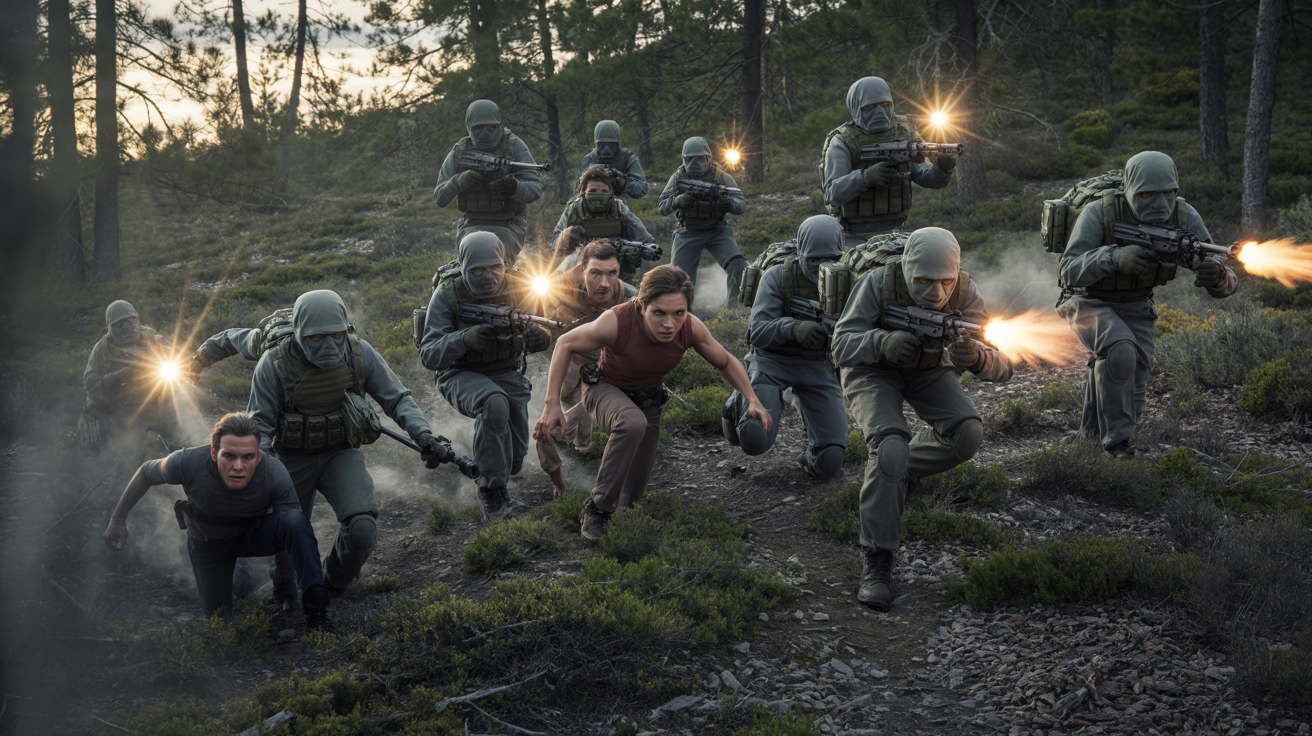
Combat Basics
The Turn Structure (~3 seconds per turn)
A turn (also called a round, the two mean the same thing) is about 3 seconds. Combat uses a three-phase system where everyone acts simultaneously:
What You Can Do Each Turn
Major Actions (one per turn):
- Attack — fire a weapon, swing a melee weapon
- Reload — reload your weapon
- Use Item — apply first aid, throw grenade, etc.
- Sprint — double your movement speed for this turn (consumes your major action)
Movement: Speed × 5 feet
Free Actions (unlimited, within reason):
- Talking, shouting warnings
- Dropping items
- Drawing or holstering weapons/items
The Three Phases
Phase 1: Intent (Declare Your Action)
Be specific about what you're doing. You commit before knowing results — this creates tension!
Phase 2: Check (Roll Dice & Resolve Skill Checks)
Roll all your dice simultaneously:
- d100 Combat skill — Will you hit?
- 1d6 Speed Die — your initiative this round (rolled fresh every round)
- +Difficulty If GM assigns — Added to your roll
- Combat: d100 = 24 (target 29, success!)
- Damage: Baseball Bat 4 + Brawn die 1d6 = 9
- Speed: 1d6 = 4
- Difficulty: +1d4 = 2
- Final: Combat 26 (24+2, still hits), Damage 9, Speed 4
Phase 3: Resolution (Act in Speed Order)
Turn Order:
- Highest Speed die goes first
- Continue in descending order
- Ties: Compare Reflex skill (Guts + Nerve tens)
On Your Turn:
- Check if your Combat roll succeeded
- If hit, compare the damage to the target's Tolerance
- Mark off ammo used
- Update injuries, Fortune
Attacking & Damage
Making an Attack
Roll ≤ skill value = Hit • Roll > skill value = Miss
Melee = weapon base + your Brawn die (e.g. Baseball Bat = 4 + 1d6) • Firearms and bows = flat damage, no roll (e.g. 9mm = 9)
Rolls 1d10 on hit location table • Or you choose (if Critical Success)
Damage < Tolerance = No injury • Damage ≥ Tolerance = Injury!
Injury Severity
| Damage vs Tolerance | Level | Penalty |
|---|---|---|
| Equals Tolerance | Level 1 | +5 to rolls |
| Exceeds by 1-4 | Level 1 | +5 to rolls |
| Exceeds by 5-8 | Level 2 | +10 to rolls |
| Exceeds by 9-12 | Level 3 | +15 to rolls, often incapacitated |
| Exceeds by 13+ | Level 4 | ☠️ DEATH |
Critical Success
How to get it:
- Roll natural 1, OR
- 5 degrees of success (the maximum)
Benefits:
- Melee: automatic max damage (base + max Brawn die)
- Firearms and bows: damage stays flat. The crit's called shot is the payoff: an unprotected headshot does double damage (see Firearm Damage)
- Knockout: an unarmed or blunt-weapon crit can knock the target out (see Melee Combat)
- Called shot (choose hit location)
- Called shots can target gaps in armor (e.g. a stab to the armpit where a vest doesn't cover). Crits don't ignore armor on their own
- Special effects (if you have traits)
Firearm Damage
A bullet's energy doesn't change from shot to shot, so firearms and bows do flat damage. Dice only decide whether you hit.
| Damage | Round |
|---|---|
| 6 | .22 |
| 9 | 9mm, .38 |
| 10 | .40, .45, .357 |
| 12 | .44 / .50 Magnum, 5.56 |
| 13 | 7.62×39, .30-30 |
| 15 | .308, .30-06 |
| 7 / 8 / 9 | Hunting bow / compound bow / crossbow |
| 28 / 14 / 7 | Buckshot within 15 ft / 15–90 ft / 90–180 ft |
| 18 / 9 / 4 | Birdshot within 15 ft / 15–60 ft / 60–120 ft |
| 14 | Shotgun slug |
Headshots: a firearm or bow hit to an unprotected head (hit location 1, with no helmet that protects against bullets) does double the flat damage. A 9mm headshot does 18. Buckshot and birdshot pellets don't double.
Shotguns: buckshot and birdshot
Shotgun pellets are powerful but dangerous. The damage depends on the shell and the distance, not on difficulty dice:
- Within 15 ft: every pellet hits the one target, for double damage (buckshot 28, birdshot 18).
- Past 15 ft, up to the shell's range (buckshot 90 ft, birdshot 60 ft): the blast spreads and hits every target in it that isn't under cover, friend or foe (buckshot 14, birdshot 9). A blast in a crowded room hits the shooter's allies too.
- Up to twice the range: half damage, still spread (buckshot 7, birdshot 4).
- Beyond twice the range: out of range, an automatic miss.
- Cover: a target in full cover isn't hit. A target in partial cover rolls Reflex: on a success the cover takes the shot and they take no damage.
A slug is one projectile and works like a rifle round: 14 damage to one target, range 100 ft, with the usual range difficulty below.
Range
Every firearm and bow has a range. Distance makes the shot harder, not weaker (buckshot and birdshot are the exception: see Shotguns above).
| Distance | Shot | Difficulty |
|---|---|---|
| Within range | Within Range | None |
| Up to 2× range | Long Shot | +2d6 |
| Up to 4× range | Crap Shot | +3d8 |
| Beyond 4× range | No shot | Automatic miss |
Ranges: pistols 50 ft • SMG 75 ft • shotgun slugs 100 ft (buckshot 90 ft and birdshot 60 ft work differently: see above) • hunting bow 100 ft • compound bow and crossbow 150 ft • assault and lever-action rifles 300 ft • hunting rifle 500 ft • scoped sniper rifle 1,000 ft
Long guns in close quarters: firing a rifle, shotgun or bow at a target within 5 feet adds +1d6 difficulty.
Defense & Survival
Static Defense (Default)
Defenders don't roll — your Combat roll determines hit/miss.
Active Defense (With Traits)
Common defensive traits: Dodge Roll, Combat Parry, Uncanny Dodge
Cover & Concealment
🧱 Partial Cover
(corner, car door, low wall)
- Attacker gets +1d6 difficulty
- Reduces damage 25% from explosions
🏰 Full Cover
(wall, inside vehicle)
- Cannot be targeted
- Reduces damage 50% from explosions
Ammunition & Reloading
Track Every Shot
Mark off each bullet/shell fired. Running dry at the wrong moment gets you killed.
Reloading (One Action)
Magazine-Fed
Full reload instantly
Revolver
Roll 1d6 for rounds loaded
Shotgun (tube)
Roll 1d6 for shells loaded
Breach-Fed
Loads full capacity (1-2)
- Revolver (6 capacity, empty)
- Reload action, roll 1d6 = 4
- Now has 4 rounds (need another action for full reload)
Weapon Jamming
3+ Degrees of Failure: GM may declare jam
- Uses 3 degrees (not Dread)
- Mechanics roll to clear (one action)
Natural 100 (Critical Failure): Weapon breaks
- Unusable until repaired
Automatic Weapons
Aimed Shot
| Fire Mode | Ammo Used | Effect |
|---|---|---|
| Full-Auto | 10 rounds | Every round fired is a hit: apply damage for each, can move normally |
| Burst | 3 rounds | Counts as 3 hits: apply damage for each, can move normally |
Suppressive Fire
| Fire Mode | Ammo Used | Area |
|---|---|---|
| Full-Auto | 30 rounds | 20-foot area |
| Burst | 6 rounds | 15-foot area |
Effects:
- Forces enemies to take cover
- Move at half Speed while firing
Enemies in suppressive fire:
- Already in cover: Safe, but +1d6 to actions
- Not in cover: Must make Reflex roll
- Success = Reach cover safely
- Failure = Take damage, then reach cover
Special Situations
Grenades
Throwing:
- Athletics roll to place accurately
- Detonates after 1 turn
- Everyone in radius takes same damage
Cover reduces damage:
- Full cover: 50% reduction
- Partial cover: 25% reduction
| Grenade | Effect |
|---|---|
| Frag | 6 + 2d8 damage, 15-foot radius |
| Flashbang | Blind/deafen (Reflex resist) |
| Smoke | 20-foot concealment |
Melee Combat
Within 5 feet = melee range. Melee damage = weapon base + your Brawn die: 1d4 (Brawn 15–24), 1d6 (Brawn 25–34), 1d8 (Brawn 35–45).
| Base | Weapons |
|---|---|
| +0 | Unarmed (fists, kicks) |
| +2 | Brass knuckles, wooden plank |
| +3 | Knife, baton/club, staff |
| +4 | Baseball bat, crowbar, hammer, combat knife |
| +5 | Lead pipe, machete, hatchet, spear |
| +6 | Pipe wrench, mace, one-handed sword or axe |
| +8 | Sledgehammer, fire axe, two-handed sword |
| +10 | Chainsaw |
Knockout: on a Critical Success with an unarmed or blunt attack, the attacker may knock the target out, even if the damage causes no injury. The target is unconscious (see Unconsciousness in the Injury Guide).
Grappling: Opposed Athletics rolls — winner controls (pin, disarm, throw). Fortune/Dread have no effect on opposed rolls
Multiple Injuries
Penalties stack from different locations:
- Broken arm (+10) + Concussion (+5) = +15 total to all skill checks
A new injury to an already injured location makes that injury worse instead (see Multiple Injuries in the Injury Guide).
- Any Level 4 = Death
- 3+ Level 3 = Death
- 5+ Level 2 = Survival roll or die
Fortune in Combat
When to Spend Fortune
- A missed attack on a dangerous enemy
- A failed Reflex roll under suppressive fire
- A failed Survival roll that would mean death
- Crucial skill check under fire
- Minor failures
- Attacks that already succeeded
- Low-stakes situations
Spending Fortune
Turn a failed roll into a success by spending degrees of failure + 1 Fortune. A natural 100 can never be saved.
Opposed rolls (e.g. grappling) neither earn nor spend Fortune, and Dread has no effect on them. Tick Opposed on the dice roller.
Gaining Fortune
Every degree of success adds 1 Fortune, on every roll (degrees max out at 5):
Medical Treatment
Field Medicine (During Combat)
One action to stabilize ally:
- Medicine roll
- Success = Stabilized: bleeding stops and the injury stops getting worse
- Requires first aid kit
Limitations:
- Does not lower the injury level; it keeps its level and penalty
- Lowering the level takes proper treatment after combat (see the Injury Guide)
- Full healing requires rest
Unconscious Allies
Medicine roll to stabilize. An unconscious ally cannot wake until stabilized:
- Can be dragged: the carrier becomes Encumbered (half Movement), or Over-Encumbered if already Encumbered by gear
- Continue to worsen if untreated
Hit Locations
| d10 | Location | Common Effects |
|---|---|---|
| 1 | Head | Concussion, vision problems |
| 2 | Neck | Arterial bleeding, suffocation |
| 3 | Chest | Broken ribs, difficulty breathing |
| 4 | Abdomen | Internal bleeding, organ damage |
| 5 | Back | Spinal injury, paralysis |
| 6 | Left Arm | Can't use arm, drops items |
| 7 | Right Arm | Can't use weapon |
| 8 | Left Leg | Movement reduced |
| 9 | Right Leg | Movement reduced |
| 10 | Hands/Feet | Can't grasp/run |
Quick Reference
Turn Timing
~3 seconds per turn
Movement
Speed × 5 feet
Actions
One action + movement
Reloading
= One action
Active Defense
Once per turn
Cover
ALWAYS use it
Attack Sequence
- Roll Combat (d100)
- Work out damage if hit (melee: base + Brawn die; guns: flat)
- Compare to Tolerance
- Apply injury penalties
Injury Penalties Quick Reference
- Level 1: +5 to rolls
- Level 2: +10 to rolls
- Level 3: +15 to rolls, often incapacitated
- Level 4: ☠️ Death
Tactical Checklist
Before Combat
- Know your weapon's effective range
- Identify cover locations
- Check ammo count
- Coordinate with team
During Combat
- Use cover religiously
- Track your ammo
- Focus fire (kill one enemy > wound three)
- Retreat when necessary
Common Mistakes
| ❌ Mistake | ✅ Fix |
|---|---|
| Standing in open | Move to cover |
| Wasting active defense | Save for big hits |
| Ignoring injuries | Get treatment ASAP |
| Shooting beyond range | Close distance first |
| Not tracking ammo | Reload during lulls |
Survival Priorities
- 1 Don't get hit — Use cover!
- 2 Hit them first — Initiative matters
- 3 Know when to run — Live to fight another day
- 4 Work as a team — Coordinate fire
- 5 Track resources — Ammo, Fortune, injuries
☠️ Dead heroes tell no tales.